
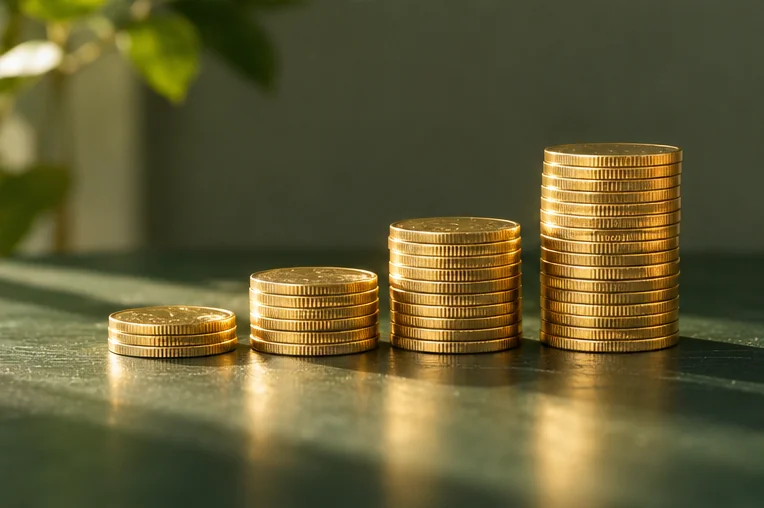
When interest stays in an account, it can earn interest of its own. You can see how much that changes your balance by separating the money you put in from the growth you’re projecting.
Start with one deposit
Imagine a $1,000 deposit earning a fixed 5% annual interest rate with annual compounding. In the first year it earns $50, for a balance of $1,050. The second year begins with $1,050, so the account earns $52.50 and ends the year with $1,102.50. The extra $2.50 in that second year comes from the interest you left in the account.
After five years, the same example reaches $1,276.28. After 10, it reaches $1,628.89. These figures use repeated annual growth of 5%, with no withdrawals, taxes, fees, or added deposits. The rate is an illustration.
Check whether the rate is an APY
An annual percentage yield (APY) expresses annualized deposit earnings and already reflects the effect of compounding under the account’s disclosed terms. If a calculator asks for a nominal annual interest rate and compounding frequency, use the nominal rate given in the account disclosure. Entering an advertised APY as a nominal rate in a monthly compounding model would count some of the compounding twice.
Separate your deposits from the interest
Consider a second illustration with a $1,000 starting balance, a 5% nominal annual rate compounded monthly, and a $50 deposit at the end of each month. After five years, the projected balance is about $4,683.66. You supplied $4,000 including the first $1,000. The remaining $683.66 is interest in this example. After 10 years, the same scenario projects about $9,411.12 on $7,000 in total contributions.
The deposit timing is part of the calculation. With end-of-month contributions, the account earns each month’s interest before the new $50 goes in. A beginning-of-month contribution has one more period to earn interest, so the projected balance is slightly higher with the other assumptions held constant.
Run the example at 0% as a check
With zero interest, the $1,000 start and 60 deposits of $50 produce exactly $4,000 after five years. This gives you a baseline for the projection. If your planned deposits alone leave a large gap to your goal, try a longer timeline or a higher contribution to see how much difference you can make without relying on growth.
Test a range you can plan around
Run the same five-year monthly example with a 3% nominal annual rate. Keeping $50 end-of-month contributions and monthly compounding brings the projection to about $4,393.95. Comparing both results shows how sensitive the total is to the interest rate, while the $4,000 you plan to supply stays the same.
For your own goal, write down the date you’ll need the money, the current balance, and a contribution you can keep making. Try a lower interest rate or a smaller contribution. Savings rates can change, and investment returns can fluctuate and include losses. Factor in any fees, taxes, or withdrawals separately when those costs apply.
Try the numbers
Compound Interest Calculator
Explore hypothetical growth from a starting amount and recurring deposits.
Sources
- U.S. Securities and Exchange Commission, Investor.gov — Compound interest definition
- U.S. Securities and Exchange Commission, Investor.gov — Compound interest calculator
- Consumer Financial Protection Bureau — How annual percentage yield is calculated
- U.S. Securities and Exchange Commission, Investor.gov — Understanding investment risk
Hazel Saves provides general financial education. Read the financial disclaimer or report an issue.